
Midwest Banjo Camp
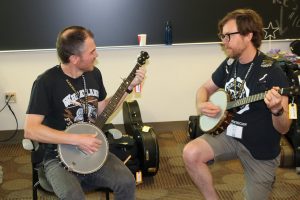 For two decades now, a gathering in the heart of midwest farm country has worked to preserve early American music. They are saving the banjo — passing the sounds from one generation to the next.
It’s an instrument that has seen it’s ups and downs. As Lily Werbin, co-owner of Elderly Instruments in Lansing, Michigan will tell you, it has a “very complex history.” It was imported from Africa during the days of slavery. By the late 19th century, it was featured in the minstrel shows. As those shows disappeared, so did the music and in some ways, so did the banjo. One of the newest lovers of the music — Lee Johnson of Stone Mountain, Georgia, says for a long time it was a “lost instrument.”
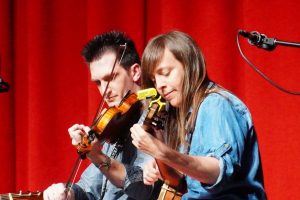 But in North Manchester, Indiana, the Midwest Banjo Camp is one of many places bringing that “lost Instrument” back to life, in a big way. In the early1940’s it became a key to the new music craze called bluegrass. So now they are teaching the old-time banjo music and the bluegrass banjo.
 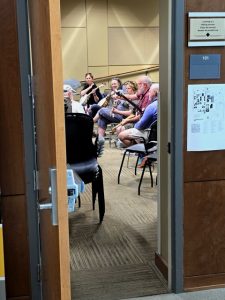 At the camp you find a wonderful mix of some of the best banjo players in the world, and some of the newest banjo players. In the classrooms and jam sessions, you hear new appreciation for the old music.
The event, started in 2005 by Stan Werbin and Ken Perlman, is held each year at Manchester University. The “campers” live in the dorms — and you can hear the sounds of jam sessions, and see the smiles of banjo lovers from all over America. Bob Fisher, who’s been playing about two years, calls it his therapy. And Perlman is thrilled at the number of young people learning the banjo. Says Ken: “every generation has its own way of doing things. So I think young people are picking it up.”
So for two decades, in this corner of the midwest, Summertime brings the sounds of the banjo — and the musicians saving our past.
Midwest Banjo Camp

For two decades now, a gathering in the heart of midwest farm country has worked to preserve early American music. They are saving the banjo — passing the sounds from one generation to the next.
It’s an instrument that has seen it’s ups and downs. As Lily Werbin, co-owner of Elderly Instruments in Lansing, Michigan will tell you, it has a “very complex history.” It was imported from Africa during the days of slavery. By the late 19th century, it was featured in the minstrel shows. As those shows disappeared, so did the music and in some ways, so did the banjo. One of the newest lovers of the music — Lee Johnson of Stone Mountain, Georgia, says for a long time it was a “lost instrument.”
But in North Manchester, Indiana, the Midwest Banjo Camp is one of many places bringing that “lost Instrument” back to life, in a big way. In the early1940’s it became a key to the new music craze called bluegrass. So now they are teaching the old-time banjo music and the bluegrass banjo. At the camp you find a wonderful mix of some of the best banjo players in the world, and some of the newest banjo players. In the classrooms and jam sessions, you hear new appreciation for the old music.
The event, started in 2005 by Stan Werbin and Ken Perlman, is held each year at Manchester University. The “campers” live in the dorms — and you can hear the sounds of jam sessions, and see the smiles of banjo lovers from all over America. Bob Fisher, who’s been playing about two years, calls it his therapy. And Perlman is thrilled at the number of young people learning the banjo. Says Ken: “every generation has its own way of doing things. So I think young people are picking it up.”
So for two decades, in this corner of the midwest, Summertime brings the sounds of the banjo — and the musicians saving our past.

Subscribe to Watch it All
Subscribe to Saving Americana and get access to all of our Big Stories and other Episodes too!

Everywhere we go there is the “Music of Americana”. A soundtrack of local music and song superseding the stories and pictures.


Showing 1-3 of 8 results
0 Comments