
Theodore Roosevelt: Reborn in the Badlands
For nearly a century, America has both honored and told the story of its presidents with the tradition of the Presidential Library. It actually began with Franklin Roosevelt at his birthplace, Hyde Park, New York. Using the resources of the National Archives, these have become thoughtful places of research, archive photos, film, and artifacts that tell the familiar and often unknown stories of our leaders.
At the JFK Presidential Library in Boston, you can see President Kennedy’s reading glasses, golf equipment, drawings by his young children, and even his dog tags, from World War Two. At the Reagan Library in Simi Valley, California, you can actually see the Air Force One he traveled on as he fought the Cold War during the 1980s. In Abeline, Kansas, at the Eisenhower Library, you can see the staff car and conference desk General Eisenhower used planning the D-Day landings during World War Two. At the new Barack Obama Presidential Library in Chicago, there are 35,000 artifacts. Things like the President’s BlackBerry and I-Pad, and thousands of gifts sent to the First Family from world leaders. In July of 2026, another Presidential Library is opening up — but totally breaking the model for all the others. The nearly half billion dollar Theodore Roosevelt Presidential Library is debuting in North Dakota to tell the story of the 26th President, and how his life “in the waning days of the western frontier,” helped rebuild his life, and took him all the way to The White House.


Everyone asks the same question: why North Dakota? For that matter, why is it being built in Medora, North Dakota, a town the 2020 census reported had just 121 year-round residents? “TR” as they call him out west, was actually born in Manhattan, New York. He lived much of his life on Long Island, at Sagamore Hill.
But after the death of his mother and his wife on Valentine’s Day, 1884, he traveled back to his Elkhorn Ranch, north of Medora in what was then the Dakota Territory, to grieve his loss. He had bought cattle and was living the life of a classic western rancher: a squatter on open range, on land he did not own. But at the Elkhorn ranch he grew physically stronger living what he called “The Strenuous Life.” And he also lived the life of a cowboy.
 As historian and author Rolf Sletten put it, “This is where he learned to get along with regular folks. In New York, he was wealthy, he was in the legislature; he went to Harvard. He was aristocratic by American standards. Cowboys out here didn’t give a lick about any of that. TR was able to ingratiate himself and finally won them over.” More than anything, he wanted to earn the respect of the cowboys. He wanted a piece of that romantic old west — before it all disappeared.
He moved on from his tragedy, and began to realize the American wilderness was changing — and not in a good way. Hunting and slaughter had nearly wiped out the buffalo. Grassland was being overgrazed. The land was being mis-used. So at the Elkhorn he became a conservationist — a protector of one of America’s greatest resources: the land. He would eventually create five national parks, the US Forest Service, and set aside millions of acres of land. But back to that question — why Medora, North Dakota? The answer is simple: it was here, in the Badlands, along the Missouri River, that Theodore Roosevelt was reborn. Back East, he re-married, raised a family, built a home on Long Island, and built a career of public service that caught the attention and fascination of the world. But he always remembered his time in the Badlands. His famous quote “I never would’ve been president, but for my time in North Dakota,” is honored frequently in the Badlands.
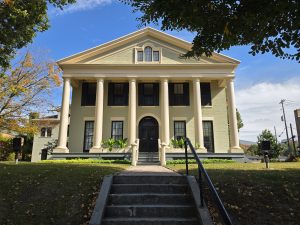 TR came to office in a hurry. On September 14, 1901, the same day President William McKinley died from an assassin’s bullet, Vice President Theodore Roosevelt was hastily sworn in as the 26th president at the Buffalo home of his friend Ansley Wilcox. McKinley had been shot at the Pan-American Exposition in Buffalo on September 6, and Roosevelt had rushed back from a trip in the Adirondacks. With the nation suddenly without a leader and the president’s body still at the Milburn House, officials and Cabinet members wanted to avoid any unseemly scene there. They chose the dignified, private setting of the Wilcox library instead. The brief, solemn ceremony—administered by U.S. District Judge John R. Hazel around 3:30 p.m.—lasted only minutes. Roosevelt borrowed formal clothes for the occasion and immediately asked the Cabinet to stay on, ensuring a smooth and rapid transition of power during a time of national shock and uncertainty.
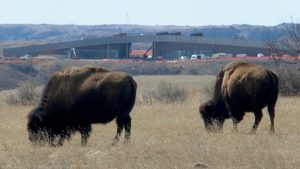
Like boom towns all over the West, the town of Medora became diminished over time. There were still the ranches and the tourism, spurred again by creating Theodore Roosevelt National Park.  The park is a great way to learn about TR — and the wilds of the Badlands, complete with buffalo that roam the 70,000 acres of the park.
  In part, because of the New Presidential Library, people will learning a lot more about one of the most remote spots in the National Park: the site of the Elkhorn Ranch, what TR called his home ranch. That building no longer exists; only a few foundation stones remain. But you will visit one of those places that has changed little since 1884, when TR was there. You can experience the quiet, the birds, the flickering of the cottonwood trees, and the total remoteness of the place. As Rolf says “You will find the Elkhorn as Roosevelt found it, and not as he left it. I would say it’s the most sacred place in North Dakota. Roosevelt wrote much of the book “Hunting Trips of a Ranchman,” at the Elkhorn. In the book and his thought, he began to realize how we must protect and preserve the land — and the wild animals. So, many call this spot this the cradle of conservation.
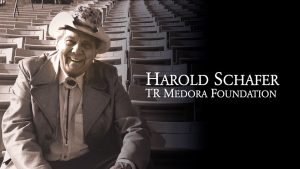 In the 60’s another one of the legends of North Dakota turned the region into one of the great family destinations, and helped keep the story of TR front and center. Harold Schafer was a self made millionaire, raised in North Dakota and always in love with the stories of Roosevelt in the Badlands. So he jumped in, saved the town, bought up and repaired old buildings, and created the Medora Musical. Most importantly, he created the Theodore Roosevelt Medora Foundation — to keep his dream going long after he was gone.
The Foundation has helped create housing, entertainment, and storytelling that connects with all generations. It’s not uncommon to see three generations of families visit Medora and experience TR and the Badlands for themselves.  Here you also can meet TR himself — well sort of. Joe Wiegand is a Theodore Roosevelt Reprisor. He looks just like Teddy and plays the part perfectly. He’s joined by Kurk Skinner, a former teacher who also looks like a slightly younger Roosevelt. He plays the part of Colonel Roosevelt from the Rough Rider Days. It’s those brief face to face meetings that may very well give you the best sense of what America loved about Teddy Roosevelt.
For some time, the Presidential Library was almost built at Dickinson State University, in Dickinson, North Dakota — east of Medora. The talk was locating it at the Theodore Roosevelt Center. The research center, founded in 2007, has a massive digital archive on Roosevelt, and is well worth a visit. According to Dr. William Hansard, of the Theodore Roosevelt Center, they have some 130 thousand items in the digital library. Part of that has to do with TR himself, who always seemed to be writing. Says Hansard, “He probably wrote about 18 million words over the course of his life and by TR’s own estimate, wrote about 150,000 letters.
Acting as the key highlight, the Presidential Library draws visitors who will also seek other locations revealing Badlands’ cultural and historical heritage. Of course, the Theodore Roosevelt Center, as mentioned above, is a must-visit. And at the North Dakota Cowboy Hall of Fame, we learn much about the ranching, rodeo and Native American culture of this region. The Hall of Honorees tells the story of all the famous faces of ranching in North Dakota, and exhibits include a section on the Elkhorn Ranch, and the Great Western Trail — tell the story of the cattle drives of the 1880s and the days of homesteading pioneers to the region.
In New Town, North Dakota, you can visit the MHA Nation Interpretive Center and learn about the tribes that hunted in the Badlands and traveled, lived, and farmed along the Missouri River before its damming. The center tells the story of the Mandan, Hidatsa and Arikara Nation, and you can discover the history of the high plains.

Artists and photographers are also telling the story of the Badlands. Chris and Gary Kman are photographers following the wild horses in and around the National Park. They document the movement of various herds of horses. They see the same groups again and again and sell the photos at heir Medora Store, Chasing Horses.They are quick to tell you that they don’t chase — they just look out of the herds and have captured images in all sorts of light — just a reminder of a National Park and the wildlife.
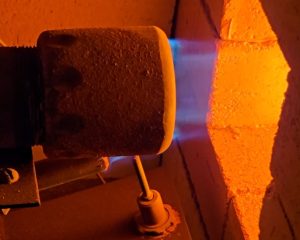 In Beech, North Dakota, at Prairie Fire Pottery, Tama Smith captures the color and feel of the Badlands in her pottery. We caught up to her on a day her kiln was firing up to 24 hundred degrees. The reds really mimic the natural color of what is called scoria. Says Tama: “The lightning starts the prairie on fire, and the prairie fire burns, and it starts the coal veins on fire in the buttes. I see. So those coal veins will burn for eons. Yes. Into the earth, into the Butte. Mm-hmm. And it’s naturally firing the clay, which is bentonite clay, um, on the top of the butte. So whenever you see.red on top of the buttes out there, you know that it’s been fired by a burning coal vein.”It all comes back to the power of the land — and how it touches so many people who visit here.
Theodore Roosevelt: Reborn in the Badlands
For nearly a century, America has both honored and told the story of its presidents with the tradition of the Presidential Library. It actually began with Franklin Roosevelt at his birthplace, Hyde Park, New York. Using the resources of the National Archives, these have become thoughtful places of research, archive photos, film, and artifacts that tell the familiar and often unknown stories of our leaders.
At the JFK Presidential Library in Boston, you can see President Kennedy’s reading glasses, golf equipment, drawings by his young children, and even his dog tags, from World War Two. At the Reagan Library in Simi Valley, California, you can actually see the Air Force One he traveled on as he fought the Cold War during the 1980s. In Abeline, Kansas, at the Eisenhower Library, you can see the staff car and conference desk General Eisenhower used planning the D-Day landings during World War Two. At the new Barack Obama Presidential Library in Chicago, there are 35,000 artifacts. Things like the President’s BlackBerry and I-Pad, and thousands of gifts sent to the First Family from world leaders. In July of 2026, another Presidential Library is opening up — but totally breaking the model for all the others. The nearly half billion dollar Theodore Roosevelt Presidential Library is debuting in North Dakota to tell the story of the 26th President, and how his life “in the waning days of the western frontier,” helped rebuild his life, and took him all the way to The White House.
Everyone asks the same question: why North Dakota? For that matter, why is it being built in Medora, North Dakota, a town the 2020 census reported had just 121 year-round residents? “TR” as they call him out west, was actually born in Manhattan, New York. He lived much of his life on Long Island, at Sagamore Hill.
But after the death of his mother and his wife on Valentine’s Day, 1884, he traveled back to his Elkhorn Ranch, north of Medora in what was then the Dakota Territory, to grieve his loss. He had bought cattle and was living the life of a classic western rancher: a squatter on open range, on land he did not own. But at the Elkhorn ranch he grew physically stronger living what he called “The Strenuous Life.” And he also lived the life of a cowboy.
As historian and author Rolf Sletten put it, “This is where he learned to get along with regular folks. In New York, he was wealthy, he was in the legislature; he went to Harvard. He was aristocratic by American standards. Cowboys out here didn’t give a lick about any of that. TR was able to ingratiate himself and finally won them over.” More than anything, he wanted to earn the respect of the cowboys. He wanted a piece of that romantic old west — before it all disappeared.
He moved on from his tragedy, and began to realize the American wilderness was changing — and not in a good way. Hunting and slaughter had nearly wiped out the buffalo. Grassland was being overgrazed. The land was being mis-used. So at the Elkhorn he became a conservationist — a protector of one of America’s greatest resources: the land. He would eventually create five national parks, the US Forest Service, and set aside millions of acres of land. But back to that question — why Medora, North Dakota? The answer is simple: it was here, in the Badlands, along the Missouri River, that Theodore Roosevelt was reborn. Back East, he re-married, raised a family, built a home on Long Island, and built a career of public service that caught the attention and fascination of the world. But he always remembered his time in the Badlands. His famous quote “I never would’ve been president, but for my time in North Dakota,” is honored frequently in the Badlands.
TR came to office in a hurry. On September 14, 1901, the same day President William McKinley died from an assassin’s bullet, Vice President Theodore Roosevelt was hastily sworn in as the 26th president at the Buffalo home of his friend Ansley Wilcox. McKinley had been shot at the Pan-American Exposition in Buffalo on September 6, and Roosevelt had rushed back from a trip in the Adirondacks. With the nation suddenly without a leader and the president’s body still at the Milburn House, officials and Cabinet members wanted to avoid any unseemly scene there. They chose the dignified, private setting of the Wilcox library instead. The brief, solemn ceremony—administered by U.S. District Judge John R. Hazel around 3:30 p.m.—lasted only minutes. Roosevelt borrowed formal clothes for the occasion and immediately asked the Cabinet to stay on, ensuring a smooth and rapid transition of power during a time of national shock and uncertainty.
Like boom towns all over the West, the town of Medora became diminished over time. There were still the ranches and the tourism, spurred again by creating Theodore Roosevelt National Park. The park is a great way to learn about TR — and the wilds of the Badlands, complete with buffalo that roam the 70,000 acres of the park. In part, because of the New Presidential Library, people will learning a lot more about one of the most remote spots in the National Park: the site of the Elkhorn Ranch, what TR called his home ranch. That building no longer exists; only a few foundation stones remain. But you will visit one of those places that has changed little since 1884, when TR was there. You can experience the quiet, the birds, the flickering of the cottonwood trees, and the total remoteness of the place. As Rolf says “You will find the Elkhorn as Roosevelt found it, and not as he left it. I would say it’s the most sacred place in North Dakota. Roosevelt wrote much of the book “Hunting Trips of a Ranchman,” at the Elkhorn. In the book and his thought, he began to realize how we must protect and preserve the land — and the wild animals. So, many call this spot this the cradle of conservation.
In the 60’s another one of the legends of North Dakota turned the region into one of the great family destinations, and helped keep the story of TR front and center. Harold Schafer was a self made millionaire, raised in North Dakota and always in love with the stories of Roosevelt in the Badlands. So he jumped in, saved the town, bought up and repaired old buildings, and created the Medora Musical. Most importantly, he created the Theodore Roosevelt Medora Foundation — to keep his dream going long after he was gone.
The Foundation has helped create housing, entertainment, and storytelling that connects with all generations. It’s not uncommon to see three generations of families visit Medora and experience TR and the Badlands for themselves. Here you also can meet TR himself — well sort of. Joe Wiegand is a Theodore Roosevelt Reprisor. He looks just like Teddy and plays the part perfectly. He’s joined by Kurk Skinner, a former teacher who also looks like a slightly younger Roosevelt. He plays the part of Colonel Roosevelt from the Rough Rider Days. It’s those brief face to face meetings that may very well give you the best sense of what America loved about Teddy Roosevelt.
For some time, the Presidential Library was almost built at Dickinson State University, in Dickinson, North Dakota — east of Medora. The talk was locating it at the Theodore Roosevelt Center. The research center, founded in 2007, has a massive digital archive on Roosevelt, and is well worth a visit. According to Dr. William Hansard, of the Theodore Roosevelt Center, they have some 130 thousand items in the digital library. Part of that has to do with TR himself, who always seemed to be writing. Says Hansard, “He probably wrote about 18 million words over the course of his life and by TR’s own estimate, wrote about 150,000 letters.
Acting as the key highlight, the Presidential Library draws visitors who will also seek other locations revealing Badlands’ cultural and historical heritage. Of course, the Theodore Roosevelt Center, as mentioned above, is a must-visit. And at the North Dakota Cowboy Hall of Fame, we learn much about the ranching, rodeo and Native American culture of this region. The Hall of Honorees tells the story of all the famous faces of ranching in North Dakota, and exhibits include a section on the Elkhorn Ranch, and the Great Western Trail — tell the story of the cattle drives of the 1880s and the days of homesteading pioneers to the region.
In New Town, North Dakota, you can visit the MHA Nation Interpretive Center and learn about the tribes that hunted in the Badlands and traveled, lived, and farmed along the Missouri River before its damming. The center tells the story of the Mandan, Hidatsa and Arikara Nation, and you can discover the history of the high plains.
Artists and photographers are also telling the story of the Badlands. Chris and Gary Kman are photographers following the wild horses in and around the National Park. They document the movement of various herds of horses. They see the same groups again and again and sell the photos at heir Medora Store, Chasing Horses.They are quick to tell you that they don’t chase — they just look out of the herds and have captured images in all sorts of light — just a reminder of a National Park and the wildlife.
In Beech, North Dakota, at Prairie Fire Pottery, Tama Smith captures the color and feel of the Badlands in her pottery. We caught up to her on a day her kiln was firing up to 24 hundred degrees. The reds really mimic the natural color of what is called scoria. Says Tama: “The lightning starts the prairie on fire, and the prairie fire burns, and it starts the coal veins on fire in the buttes. I see. So those coal veins will burn for eons. Yes. Into the earth, into the Butte. Mm-hmm. And it’s naturally firing the clay, which is bentonite clay, um, on the top of the butte. So whenever you see.red on top of the buttes out there, you know that it’s been fired by a burning coal vein.”It all comes back to the power of the land — and how it touches so many people who visit here.
Subscribe to Watch it All
Subscribe to Saving Americana and get access to all of our Big Stories and other Episodes too!

“Keepers of Americana” are the folks preserving history in museums and non-profits.


Showing 1-3 of 29 results
0 Comments