
Small Town Americana: Longview, Washington
All along the great rivers of America, you find big cities and small towns using those rivers for commerce. Before trains, trucks and airplanes, America moved on the water. And rivers became the highways that linked the country and moved goods. Thanks to the works of Mark Twain, Americans will always have a soft spot for the romance of the Mississippi River. But really on many a big river and thousands of smaller tributaries, the early stories of America were born. Such is the case on the Columbia River, in Washington State. As timber supplies declined in the midwest and deep south, timber barons looked to the massive forests of the Pacific Northwest. 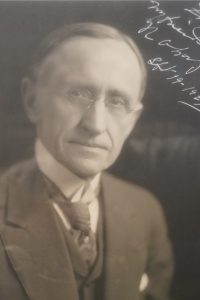
Robert A. Long had built a timber empire based in Kansas City, Missouri. In the early 20th Century he moved it west — and created one of America’s first planned cities near Kelso, Washington. As the Long-Bell company drained a swamp along the Columbia River, and began building the largest lumber mill in the world — a new town was born: Longview, Washington. Although the Long-Bell company is gone, Longview continues to thrive — a classic small town that has always dreamed big.
It is a perfect location for lumber based industry, because of the river. The deep water port of Longview is just over 60 miles from the Pacific Ocean, and you can see a steady stream of ships and barges moving west and east along the Columbia. Now several companies have operations in Longview, including Weyerhaeuser, which has been here in a big way since the 1920’s — even building a bigger mill than the Long-Bell facility in 1929. But all over town, you see signs of a timber town on the move.
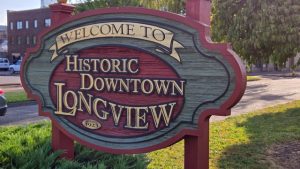 What makes it unique, goes back to R.A. Long, who knew he needed a place for employees to live — so his team designed a city for 50,000 workers. It never got that big, but all over you can see the signs of a community that has mapped out its future. “It was modeled off of Washington D.C., Rome, France, like the great cities. This is why you get the hub and spoke pattern,” says Nick Little, the cities Community and Economic Development Director. “It was actually fully planned before we ever put streets down,” says Longview City Manager Jennifer Wills.
A key part of the plan was Lake Sacajawea Park. A 3.5 mile trail goes around the lake and sees a steady stream of walkers on any given day. The man made lake is fed with water from the Cowlitz River, and eventually flows into the Columbia. It also acts as a sort of flood control overflow system.
One of the highlights of the park is a network of bridges built just for squirrels. 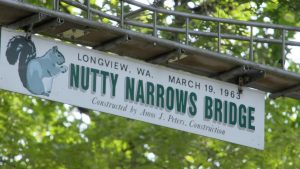 The first one, the “Nutty Narrows Bridge,” was built in 1963 by local architect Amos Peters. It’s quite a story and shows you what one person can achieve. According to city records: “Peters and others who worked in and near Park Plaza, witnessed squirrels being run over. One day Peters found a dead squirrel with a nut still in its mouth, and that day’s coffee break discussion turned into squirrel safety. The group of businessmen cooked up the squirrel bridge idea and formed a committee to ask the City Council’s blessing. The Council approved, and Councilwoman Bess LaRiviere jokingly dubbed the bridge
 Nutty Narrows.
The name stuck.”
In the years since, several other bridges have been put up. They are placed 30 feet over roads — many leading into the park. The bridges have gotten attention around the world and the city created an annual event: Squirrel Fest. It celebrates the towns fascination with the critters that have brought it so much fame.
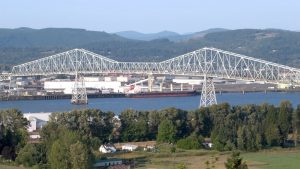
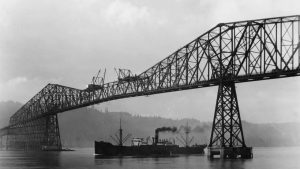 And Longview, and the city of Rainier, Oregon have added a yearly event — a 10K fun run across the Lewis and Clark Bridge, over the Columbia River. The “R to L Bridge Run,” has become a popular event and gives people a rare look at the views from the top of the bridge. The historic bridge was built in the late 1920’s and early 30’s and was designed by engineer Joseph Strauss, who later designed and built the Golden Gate Bridge, in San Francisco.
Longview is also a gateway to Mount St. Helens. The 1980 eruption left a trail of destruction around the region, and a fascination that continues. 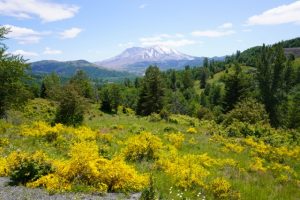 Thousands of tourists make the trip each year — some even climbing the mountain. A series of interpretation centers line the Spirt Lake Highway, east of I-5. In Castle Rock, we visited The Mount St. Helens Visitor Center run by the state of Washington. Here you can learn the story of Mount St. Helens, and the other volcanos that make up the Cascade Mountain Range.
Small Town Americana: Longview, Washington

All along the great rivers of America, you find big cities and small towns using those rivers for commerce. Before trains, trucks and airplanes, America moved on the water. And rivers became the highways that linked the country and moved goods. Thanks to the works of Mark Twain, Americans will always have a soft spot for the romance of the Mississippi River. But really on many a big river and thousands of smaller tributaries, the early stories of America were born. Such is the case on the Columbia River, in Washington State. As timber supplies declined in the midwest and deep south, timber barons looked to the massive forests of the Pacific Northwest.
Robert A. Long had built a timber empire based in Kansas City, Missouri. In the early 20th Century he moved it west — and created one of America’s first planned cities near Kelso, Washington. As the Long-Bell company drained a swamp along the Columbia River, and began building the largest lumber mill in the world — a new town was born: Longview, Washington. Although the Long-Bell company is gone, Longview continues to thrive — a classic small town that has always dreamed big.
It is a perfect location for lumber based industry, because of the river. The deep water port of Longview is just over 60 miles from the Pacific Ocean, and you can see a steady stream of ships and barges moving west and east along the Columbia. Now several companies have operations in Longview, including Weyerhaeuser, which has been here in a big way since the 1920’s — even building a bigger mill than the Long-Bell facility in 1929. But all over town, you see signs of a timber town on the move.
What makes it unique, goes back to R.A. Long, who knew he needed a place for employees to live — so his team designed a city for 50,000 workers. It never got that big, but all over you can see the signs of a community that has mapped out its future. “It was modeled off of Washington D.C., Rome, France, like the great cities. This is why you get the hub and spoke pattern,” says Nick Little, the cities Community and Economic Development Director. “It was actually fully planned before we ever put streets down,” says Longview City Manager Jennifer Wills.
A key part of the plan was Lake Sacajawea Park. A 3.5 mile trail goes around the lake and sees a steady stream of walkers on any given day. The man made lake is fed with water from the Cowlitz River, and eventually flows into the Columbia. It also acts as a sort of flood control overflow system.
One of the highlights of the park is a network of bridges built just for squirrels. The first one, the “Nutty Narrows Bridge,” was built in 1963 by local architect Amos Peters. It’s quite a story and shows you what one person can achieve. According to city records: “Peters and others who worked in and near Park Plaza, witnessed squirrels being run over. One day Peters found a dead squirrel with a nut still in its mouth, and that day’s coffee break discussion turned into squirrel safety. The group of businessmen cooked up the squirrel bridge idea and formed a committee to ask the City Council’s blessing. The Council approved, and Councilwoman Bess LaRiviere jokingly dubbed the bridge Nutty Narrows.
The name stuck.”
In the years since, several other bridges have been put up. They are placed 30 feet over roads — many leading into the park. The bridges have gotten attention around the world and the city created an annual event: Squirrel Fest. It celebrates the towns fascination with the critters that have brought it so much fame.
And Longview, and the city of Rainier, Oregon have added a yearly event — a 10K fun run across the Lewis and Clark Bridge, over the Columbia River. The “R to L Bridge Run,” has become a popular event and gives people a rare look at the views from the top of the bridge. The historic bridge was built in the late 1920’s and early 30’s and was designed by engineer Joseph Strauss, who later designed and built the Golden Gate Bridge, in San Francisco.
Longview is also a gateway to Mount St. Helens. The 1980 eruption left a trail of destruction around the region, and a fascination that continues. Thousands of tourists make the trip each year — some even climbing the mountain. A series of interpretation centers line the Spirt Lake Highway, east of I-5. In Castle Rock, we visited The Mount St. Helens Visitor Center run by the state of Washington. Here you can learn the story of Mount St. Helens, and the other volcanos that make up the Cascade Mountain Range.
8 Comments
Leave a Reply

Subscribe to Watch it All
Subscribe to Saving Americana and get access to all of our Big Stories and other Episodes too!

In “Small Town Americana”, we visit off-the-interstate places that seem unchanged.


Showing 1-3 of 33 results
Thank you for featuring my home town!! There’s much more here, if you visit again!
It is a wonderful town — and great people.
The dialogue mentions Mount Saint Helens blowing in 1981. It was 1980.
FIXED!
Thanks for pointing that out.
Dave C
The squirrels also use the crosswalks around town. I absolutely adore them!!
Well done video; however the still much in use YWCA and active Longview Community Church, essential to the community would have enhanced the presentation.
Mt Saint Helens Blew its top off in May 18th 1980. NOT 1981 … WHICH WAS SAID …
Thanks for catching that. I am getting it fixed.