
Small Town Americana: Lewiston, New York
 As we travel America, we see constant examples of big cities, or famous places overshadowing smaller, nearby communities. Yet again and again we find those small towns are really interesting — and full of history. Such is the case with Lewiston, New York, north of Buffalo, near Niagara Falls.
Actually, this is where Niagara Falls started to chip away all the rock. 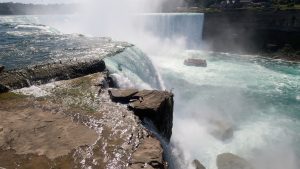 Twelve thousand years ago, and 7 miles down stream from the current location, you would have seen the falls right where Lewiston lives now. Through the gorge you find fast moving rapids pinned in by steep walls. Native Americans, French, British and American Colonists, and early explorers heading to or from the frontier, had to get around this barrier. So for centuries, a long portage around the falls brought people through this area watched over by the Seneca Tribe.
The Senecas were part of the Five Nation Indian Alliance established in the 15th century. Called the “Keepers of the Western Door,” they were in charge of Niagara Falls, Lake Erie and Lake Ontario. That would include the Niagara Portage — a gap in the gorge walls that allowed goods and people to get around the falls. The Historical Association of Lewiston runs tours and a museum on the towns fascinating history.
 Lewiston was the major spot for people and materials transported on the portage. It made Lewiston a key city in western New York and a key in the exploration and settlement of the Midwest. As town civic leader Lee Simonson says, “if it wasn’t for Lewiston, there would be no Cleveland, Detroit or Chicago.” That changed in 1825 when the Erie Canal opened between Albany and Buffalo — putting the portage out of business.
But over the years, Lewiston has seen it’s share of historic events. This is where the first battle of the war of 1812 was fought — what some call “The Revolutionary War 2 point 0.” The Americans first crossed into Canada, but the British later attacked and burned the town.
 More Americans would have died were it not for Native Americans from the the local Tuscarora village who offered the first resistance the British had seen that day The Tuscarora’s diversionary tactics gave the impression that their “numbers were legion.” Fearing a trap, the enemy stopped in its tracks, giving the the escaping residents time to get out of harm’s way. The story is told through a fascinating sculpture called the Tuscarora Heroes Monument. Despite being outnumbered thirty to one, the “Tuscarora Heroes” saved the lives of dozens of Americans and the monument, on Center Street attracts a lot of attention.
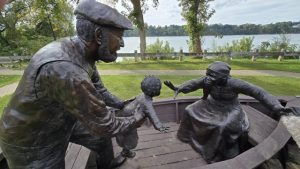
Another Lewiston sculpture tells the story of the town helping fleeing slaves reach safety across the river, In Canada. The Freedom Crossing Monument is located on a bluff overlooking the Niagara River.
 It represents the story first told by author Margaret Goff Clark in her book Freedom Crossing. In the book, read by millions of grade school students, teenager Laura Eastman and a Lewiston underground railroad conductor Josiah Tryon, risked arrest helping slaves escape across the river. Tryon was a real person — a tailor in Lewiston.
Across America, there are thousands of towns and people who helped the slaves escape north to Canada, but here in Lewiston, it’s just so powerful to look that short distance across the river and imagine the terror of being so close to freedom, but still in much danger. The monument, created by Youngstown, New York artist Susan Geissler, has drawn thousands of visitors to this special community that works so hard to preserve and showcase history.
Small Town Americana: Lewiston, New York

As we travel America, we see constant examples of big cities, or famous places overshadowing smaller, nearby communities. Yet again and again we find those small towns are really interesting — and full of history. Such is the case with Lewiston, New York, north of Buffalo, near Niagara Falls.
Actually, this is where Niagara Falls started to chip away all the rock. Twelve thousand years ago, and 7 miles down stream from the current location, you would have seen the falls right where Lewiston lives now. Through the gorge you find fast moving rapids pinned in by steep walls. Native Americans, French, British and American Colonists, and early explorers heading to or from the frontier, had to get around this barrier. So for centuries, a long portage around the falls brought people through this area watched over by the Seneca Tribe.
The Senecas were part of the Five Nation Indian Alliance established in the 15th century. Called the “Keepers of the Western Door,” they were in charge of Niagara Falls, Lake Erie and Lake Ontario. That would include the Niagara Portage — a gap in the gorge walls that allowed goods and people to get around the falls. The Historical Association of Lewiston runs tours and a museum on the towns fascinating history.
Lewiston was the major spot for people and materials transported on the portage. It made Lewiston a key city in western New York and a key in the exploration and settlement of the Midwest. As town civic leader Lee Simonson says, “if it wasn’t for Lewiston, there would be no Cleveland, Detroit or Chicago.” That changed in 1825 when the Erie Canal opened between Albany and Buffalo — putting the portage out of business.
But over the years, Lewiston has seen it’s share of historic events. This is where the first battle of the war of 1812 was fought — what some call “The Revolutionary War 2 point 0.” The Americans first crossed into Canada, but the British later attacked and burned the town.
More Americans would have died were it not for Native Americans from the the local Tuscarora village who offered the first resistance the British had seen that day The Tuscarora’s diversionary tactics gave the impression that their “numbers were legion.” Fearing a trap, the enemy stopped in its tracks, giving the the escaping residents time to get out of harm’s way. The story is told through a fascinating sculpture called the Tuscarora Heroes Monument. Despite being outnumbered thirty to one, the “Tuscarora Heroes” saved the lives of dozens of Americans and the monument, on Center Street attracts a lot of attention.
Another Lewiston sculpture tells the story of the town helping fleeing slaves reach safety across the river, In Canada. The Freedom Crossing Monument is located on a bluff overlooking the Niagara River.
It represents the story first told by author Margaret Goff Clark in her book Freedom Crossing. In the book, read by millions of grade school students, teenager Laura Eastman and a Lewiston underground railroad conductor Josiah Tryon, risked arrest helping slaves escape across the river. Tryon was a real person — a tailor in Lewiston.
Across America, there are thousands of towns and people who helped the slaves escape north to Canada, but here in Lewiston, it’s just so powerful to look that short distance across the river and imagine the terror of being so close to freedom, but still in much danger. The monument, created by Youngstown, New York artist Susan Geissler, has drawn thousands of visitors to this special community that works so hard to preserve and showcase history.
3 Comments
Submit a Comment

Subscribe to Watch it All
Subscribe to Saving Americana and get access to all of our Big Stories and other Episodes too!

In “Small Town Americana”, we visit off-the-interstate places that seem unchanged.


Showing 1-3 of 33 results
This is great, thank you! I believe the Erie Canal opened in 1825, not 1925 as you state here.
Coleen. Thanks so much for catching this. I really need a second set of eyes some times.
Brent Baader
Very interesting, my ancestors were from Lewiston, the Cooke family. I had no idea it was so historical, especially the role the townspeople played in helping the enslaved people escape to Canada.