
Miami & Erie Canal, Piqua, Ohio
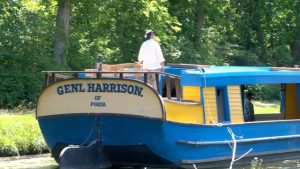 It’s hard to imagine a time when freight and passengers could move hundreds of miles — at just three miles an hour. Such were the days of America’s canals. Mules or sometimes horses would pull the packet and freight boats on canals all over the east coast and midwest. They started building the canals in the early 19th century. Before that, it was just wagons that would move crops and raw material one direction — finished products the other way. Perhaps the most famous of the waterways — New York’s Erie Canal — gets most of the attention. It turns 200 years old in 2025, and is still a working canal — widened and expanded several times.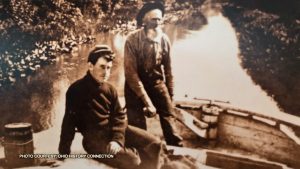
Like all victims of progress, most of the canals were eventually put out of business by the trains. Many of the waterways are virtually gone — just old locks, and a few sections of stagnant water remain. For a time, the C&O Canal in Washington D.C. was almost paved over and turned into a highway.
But across America sections of the canals do remain. History lovers have begun to restore parts of the old water highways — just to help us remember our past. At many locations, boats have been built and still operate — though most just run on electric motors these days.
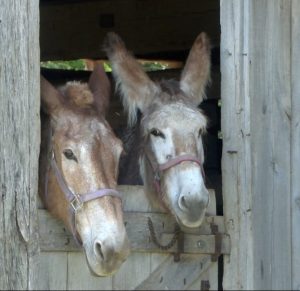 You will find a different experience north of Dayton, Ohio, In the town of Piqua, at the Johnston Farm & Indian Agency. It’s a part of the Ohio History Connection. From April through October, you can ride the Canal Boat General Harrison, a 70 foot long replica. Two mules walk the tow path on the section of restored the Miami & Erie Canal just has they would have done back in the day. It was built between 1825 and 1845 and connected Toledo, Ohio on Lake Erie, to Cincinnati, on the Ohio River. Costumed guides make for an authentic experience and work with the mules constantly.
 “It’s an important part of our history,” says manager Ben Richard. “Here at our site we’re trying to keep that alive. The site is a great draw because people get to come and actually ride on the canal boat and see what life was like in the 1800s,”
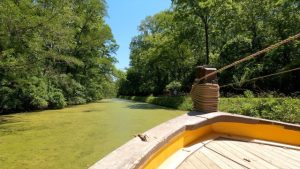
Canals were different than traveling on oceans, lakes or rivers, where waves and rapids were a constant fear. Here in Piqua, you realize how smooth the ride was –flat water and just a gentle steady pull of the mules. Here you learn and feel the canal history — just as it was nearly two centuries ago.
Miami & Erie Canal, Piqua, Ohio
It’s hard to imagine a time when freight and passengers could move hundreds of miles — at just three miles an hour. Such were the days of America’s canals. Mules or sometimes horses would pull the packet and freight boats on canals all over the east coast and midwest. They started building the canals in the early 19th century. Before that, it was just wagons that would move crops and raw material one direction — finished products the other way. Perhaps the most famous of the waterways — New York’s Erie Canal — gets most of the attention. It turns 200 years old in 2025, and is still a working canal — widened and expanded several times.
Like all victims of progress, most of the canals were eventually put out of business by the trains. Many of the waterways are virtually gone — just old locks, and a few sections of stagnant water remain. For a time, the C&O Canal in Washington D.C. was almost paved over and turned into a highway.
But across America sections of the canals do remain. History lovers have begun to restore parts of the old water highways — just to help us remember our past. At many locations, boats have been built and still operate — though most just run on electric motors these days.
You will find a different experience north of Dayton, Ohio, In the town of Piqua, at the Johnston Farm & Indian Agency. It’s a part of the Ohio History Connection. From April through October, you can ride the Canal Boat General Harrison, a 70 foot long replica. Two mules walk the tow path on the section of restored the Miami & Erie Canal just has they would have done back in the day. It was built between 1825 and 1845 and connected Toledo, Ohio on Lake Erie, to Cincinnati, on the Ohio River. Costumed guides make for an authentic experience and work with the mules constantly.
“It’s an important part of our history,” says manager Ben Richard. “Here at our site we’re trying to keep that alive. The site is a great draw because people get to come and actually ride on the canal boat and see what life was like in the 1800s,”
Canals were different than traveling on oceans, lakes or rivers, where waves and rapids were a constant fear. Here in Piqua, you realize how smooth the ride was –flat water and just a gentle steady pull of the mules. Here you learn and feel the canal history — just as it was nearly two centuries ago.
1 Comment
Leave a Reply

Subscribe to Watch it All
Subscribe to Saving Americana and get access to all of our Big Stories and other Episodes too!

“Keepers of Americana” are the folks preserving history in museums and non-profits.


Showing 1-3 of 29 results
The canal is just part of what Johnston Farm and Indian Agency has to offer. Visit the Johnston Family home, with its outdoor summer kitchen and 2 story spring house. Stop in and be awed at the wonders of the largest and oldest log barn in Ohio. The museum highlights the Native American history in Ohio as well as the canal systems. The gardens are being started with many plants from the 1800s